
Residency First or Property First? The Correct Order for Renting or Buying in Mexico

Updated September 2026
You have decided that Mexico may be the right place for your next chapter. Now comes the question that causes a surprising amount of confusion:
Should you obtain Mexican residency first, or should you find a property first?
The short answer is that a foreigner does not normally need Mexican residency simply to rent or buy property. However, that does not mean immigration and real estate should be planned separately.
Your intended length of stay, source of income, preferred location, banking needs and plans for the property can affect the correct order. A buyer purchasing a vacation condominium in Playa del Carmen has different needs from a family relocating permanently to Mérida.
A retiree seeking a 12-month rental also has different priorities from an investor planning to generate rental income.
This guide explains how to coordinate the two processes before you sign a lease, transfer a deposit or commit to a purchase.
Quick answer: If you are still deciding where to live, begin the immigration review first and rent before buying. If you already know the location and are purchasing a vacation or investment property, you can normally begin the property process without waiting for residency. In either case, have the immigration and real-estate timelines reviewed together.

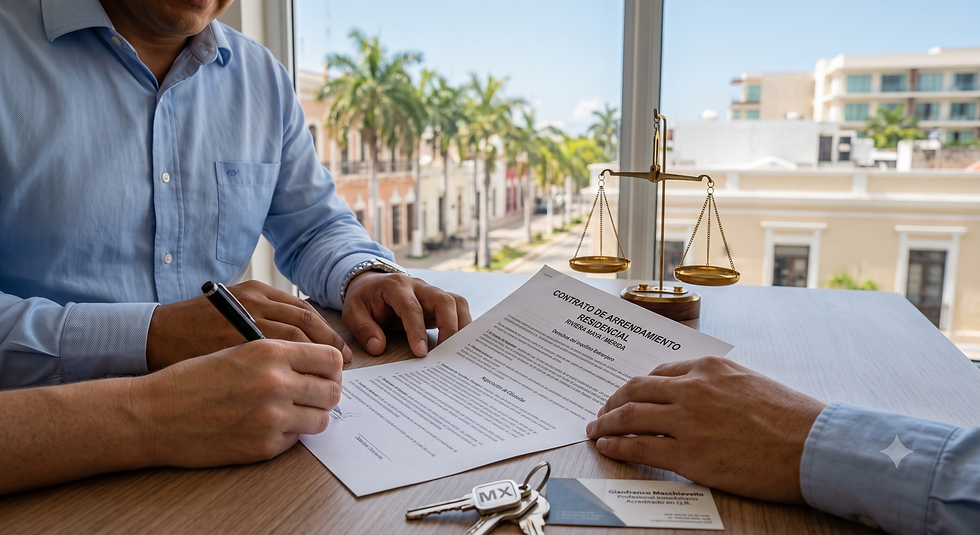
Do You Need Mexican Residency to Rent a Property?
Mexican residency is not generally a universal legal requirement for signing a private residential lease. In practice, however, each landlord may establish reasonable application requirements.
A landlord or property manager may request:
A valid passport
Proof of lawful entry or immigration status
Proof of income or recent bank statements
Personal or professional references
A Mexican guarantor, known as an aval
A legal protection policy, often called a póliza jurídica
A larger security deposit when the tenant has no Mexican credit or rental history
Both tenants' names and signatures when two adults will occupy the property
This is where many international renters become frustrated. They may be financially qualified, but their documents do not fit the landlord's usual approval process.
An experienced rental representative can ask about the requirements before a viewing, confirm whether foreign income will be accepted and prevent the client from spending time on a property they cannot realistically secure.
Can you sign a long-term lease while in Mexico as a visitor?
It may be possible to sign a lease as a visitor, subject to the landlord's requirements and the terms of the contract. But signing a lease does not extend the period you are authorized to remain in Mexico, change your immigration status or authorize you to work.
Mexico distinguishes between immigration categories and whether a foreign national has permission to perform paid activities. The status granted upon entry controls your authorized stay—not the length printed in a rental agreement.
If you intend to live in Mexico beyond a short visit, speak with a qualified immigration professional before relying on a long-term lease as your relocation plan.
Do You Need Mexican Residency to Buy Property?
Foreigners can legally acquire real estate in Mexico, and Mexican residency is not normally a prerequisite to purchase.
What changes is the ownership structure.
Property outside the restricted zone
Outside the constitutionally defined restricted zone, a foreign buyer can generally hold title directly, subject to the applicable foreign-investment requirements and the clause through which the buyer agrees to be treated as a Mexican national regarding the property.
Property inside the restricted zone
Mexico's restricted zone covers land within 100 kilometers of an international border and 50 kilometers of the coastline. Residential property purchased by a foreigner in this zone is commonly held through a Mexican bank trust known as a fideicomiso.
This is especially relevant to buyers in:
Cancún
Playa del Carmen
Tulum
Puerto Morelos
The Riviera Maya
Progreso and other parts of the Yucatán coast
Under this structure, a Mexican bank serves as trustee while the foreign buyer is named as beneficiary and receives the rights established in the trust. Authorization from Mexico's Ministry of Foreign Affairs forms part of the regulated process.
The structure of the acquisition should be confirmed by the notary and legal professionals handling the transaction. It should never be explained merely as “foreigners cannot own property near the beach,” because that statement is incomplete and misleading.
Does Buying Property Automatically Give You Mexican Residency?
No. Purchasing a house or condominium in Mexico does not automatically grant temporary or permanent residency.
Property ownership and immigration status are separate legal matters.
Mexico has several possible paths to residency, including economic-solvency, family-unity and other qualifying categories. Certain investment-based applications may exist when specific legal and financial requirements are met, but buying an ordinary home does not itself guarantee approval.
Applicants should also avoid relying on a single income or savings figure found in a social-media post. Economic-solvency calculations and documentary requirements can change, and consulates may publish their own current instructions. Confirm the requirements with the Mexican consulate where you will apply and with a qualified immigration professional.
Should You Apply for Residency Before Coming to Mexico?
For many applicants seeking temporary or permanent residency, the process begins at a Mexican consulate outside Mexico. After approval and entry, the applicant generally completes the in-country exchange process with the National Migration Institute within the applicable deadline.
That is why the immigration conversation should happen before booking a one-way move, shipping household belongings or signing a lease that assumes you can remain for an entire year.
Your immigration professional should review:
Your nationality and current country of residence
The purpose and expected length of your stay
Income, pension, savings or investment evidence
Family connections in Mexico
Whether you intend to work or earn income in Mexico
The correct consulate and its current requirements
Which original documents, apostilles or translations may be needed
Starting this review early does not mean you must delay the property search. It means the home search can be organized around a realistic arrival date.
The Best Order for Most People Moving to Mexico
There is no single sequence for every client, but the following order works well for many international relocations.
Step 1: Clarify how you will use the property
Decide whether the property will be:
Your full-time home
A seasonal residence
A long-term rental while you explore the area
An investment property
A home that may later be rented out
This decision affects the location, ownership structure, budget, tax questions and immigration planning.
Step 2: Complete an immigration eligibility review
Before committing financially, determine which residency route may apply, where the application should begin and how long the process may take.
This is particularly important for clients who intend to work, operate a business or remain in Mexico beyond the time authorized at entry.
Step 3: Choose the city—and the lifestyle, not only the property
Mérida, Cancún and the Riviera Maya offer very different daily experiences.
Consider:
Climate and humidity
Access to hospitals and specialists
Transportation and whether you need a car
Proximity to an airport
Internet reliability
Electricity costs
Water pressure, filtration and softening
Noise and construction near the property
Pet restrictions
Long-term rental supply
Hurricane exposure and insurance near the Caribbean coast
A beautiful listing photograph cannot tell you how the property will function in daily life.
Step 4: Rent first if you are uncertain
For someone relocating full-time, a six- or twelve-month rental can be a very sensible test period. It allows you to experience the neighborhood, weather, traffic and cost of living before purchasing.
Renting first is especially valuable when:
You have never lived in the city
You are choosing between Mérida and the Riviera Maya
You are unsure whether you need a car
You have medical, mobility or pet requirements
You are unfamiliar with local utilities and maintenance
Your residency timeline is still developing
Renting first is not wasted money if it prevents an expensive purchase in the wrong location.
Step 5: Prepare your financial trail
Whether renting or buying, keep a clear record of where funds come from. Banks, notaries, developers, landlords and compliance professionals may request supporting documents.
Prepare items such as:
Recent bank statements
Proof of employment, pension or business income
Identification matching the name used in the transaction
Marriage documents when ownership or funds involve a spouse
Evidence supporting the source of a large transfer
Certified translations or apostilles when required
Do not send a major property payment until the receiving instructions and transaction documents have been independently verified.
Step 6: Review RFC and tax needs early
The RFC is Mexico's federal taxpayer registration number. A foreign client may encounter RFC questions when purchasing, selling, invoicing, opening certain accounts, receiving income or completing other formalities.
The correct requirement depends on the transaction and the person's activities. SAT's current RFC registration guidance for foreign applicants includes a valid immigration document among the required identification documents for the applicable procedure.
Do not assume that every foreign buyer needs exactly the same tax setup. Ask the notary and a qualified Mexican accountant what will be required for your specific purchase, sale or rental-income plan.
Step 7: Conduct legal and physical due diligence
Residency approval does not make a property safe to buy, and a good property does not solve an immigration problem.
Before purchasing, the buyer's team should verify matters appropriate to the transaction, which may include:
The seller's identity and authority to sell
The public deed and Public Registry information
Liens and encumbrances
Property-tax and water-account status
Condominium fees and regulations
Construction permits and discrepancies
Ejido or agrarian issues affecting land
Assignment restrictions in a presale contract
Vacation-rental or long-term-rental restrictions
The proposed fideicomiso when required
Closing costs, taxes and payment instructions
For a rental, inspect the contract, inventory and condition report before paying the deposit.
Who Should Rent First—and Who May Be Ready to Buy?
Renting first may be better if:
You are moving to Mexico for the first time
You have not chosen between Mérida, Cancún or Playa del Carmen
Your immigration eligibility has not been reviewed
You need to test healthcare, schools or transportation
You are relying on remote income and need to verify work and banking logistics
You are unsure whether the climate suits you year-round
Buying may make sense sooner if:
You already know the area well
You have a clear long-term or investment objective
Your purchase funds and source documents are ready
You understand the ownership structure
Independent legal and notarial due diligence will be completed
The purchase will not leave you without reserves for closing, furnishing, maintenance and emergencies
The correct answer is not based on whether renting or buying is “better.” It depends on how much uncertainty remains.
A Practical Moving-to-Mexico Timeline
Three to six months before moving
Have your immigration eligibility reviewed
Decide whether you are renting or buying first
Compare Mérida, Cancún and Riviera Maya locations
Organize financial and civil documents
Establish a realistic total housing budget
One to three months before moving
Confirm the visa or residency application sequence
Begin a targeted property search
Learn landlord or purchase requirements
Arrange remote or in-person viewings
Review how deposits and funds will be transferred
Before signing or paying
Confirm the identity and authority of the owner, seller or developer
Read the complete contract
Verify deposit and refund terms
Confirm what is included with the property
Obtain appropriate legal, tax and notarial advice
Make sure the agreement fits your actual immigration timeline
After arriving
Complete any required immigration exchange or registration step on time
Document the property's condition
Update utility, banking and tax arrangements as applicable
Keep signed agreements and payment records together
Common Mistakes International Clients Make
1. Believing a property purchase includes residency
It does not. Treat the immigration application and the real-estate transaction as connected but separate processes.
2. Signing a 12-month lease without confirming how long they may stay
A lease does not override immigration law or the period authorized upon entry.
3. Choosing a property before understanding daily life
Distance to the beach is not the only consideration. Electricity, water systems, transportation, medical access and seasonal conditions can matter more after the first month.
4. Sending money before due diligence
Excitement and urgency are not substitutes for document verification.
5. Assuming every landlord accepts foreign applicants the same way
Income evidence, guarantor requirements, deposits and legal policies vary by owner and property.
6. Waiting until closing to ask about the RFC or source of funds
Administrative and compliance issues are much easier to address before a deadline.
7. Using several professionals who never communicate
The immigration advisor may not know the lease begins next week. The agent may not know the client must leave Mexico to complete a consular step. The notary may discover too late that a document or tax registration is missing.
Coordination is what turns several separate services into a workable relocation plan.
Frequently Asked Questions
Can a foreigner buy property in Mexico without residency?
Yes. Mexican residency is not normally required simply to purchase property. The correct ownership structure depends partly on whether the property is inside the restricted coastal or border zone.
Can a foreigner rent an apartment in Mexico without residency?
Residency is not generally a universal requirement for a private lease, but the landlord may require a passport, proof of immigration status, proof of income, references, a guarantor, a legal policy or an additional deposit.
Does buying a house in Mexico qualify me for residency?
Not automatically. A property purchase and a residency application are separate processes. An investment route may apply only when the current legal and financial requirements are satisfied.
Should I obtain residency before moving to Mexico?
Have your eligibility and application sequence reviewed before moving. Many residency applications begin at a Mexican consulate outside Mexico, followed by an in-country completion process after entry.
Is it better to rent before buying in Mérida or the Riviera Maya?
For first-time residents, renting for six to twelve months can reduce risk by allowing them to test the neighborhood, climate, transportation, property systems and true monthly costs. Clients who already know the area and have a clear investment or lifestyle objective may be ready to buy sooner.
Do I need an RFC to buy property in Mexico?
RFC requirements can depend on the transaction, notary and the buyer's tax or immigration circumstances. Confirm the requirement early with the notary and a qualified Mexican accountant rather than waiting until closing.
Can I work in Mexico after renting or buying a property?
Renting or owning property does not itself authorize paid work. Work authorization depends on your immigration status and applicable permission.
One Coordinated Plan for Your Move
Finding a home is only one part of relocating to Mexico.
At Gian Mexico Real Estate Group, we assist international and Mexican clients with:
Property purchases and sales
Long-term rentals of six to twelve months
Relocation property searches
Investment properties
Property management
Coordination with immigration professionals
Access to legal and notarial support for the transaction
Our team works across Mérida, Cancún, Playa del Carmen and the Riviera Maya. Through our immigration-agency partnership, we can help clients organize the property search around the appropriate immigration process instead of treating the two decisions separately.
Planning to move, rent or buy in Mexico?
Contact Gian Mexico Real Estate Group for a consultation.
WhatsApp: Send us a message
Website: www.gianmexico.com
This article provides general information and is not legal, immigration, tax or financial advice. Requirements depend on the applicant, consulate, property and transaction. Always obtain advice from appropriately qualified professionals before making a decision.
Facebook: Gian Mexico Real Estate Group
Instagram: @gianmexicoregroup


Comments